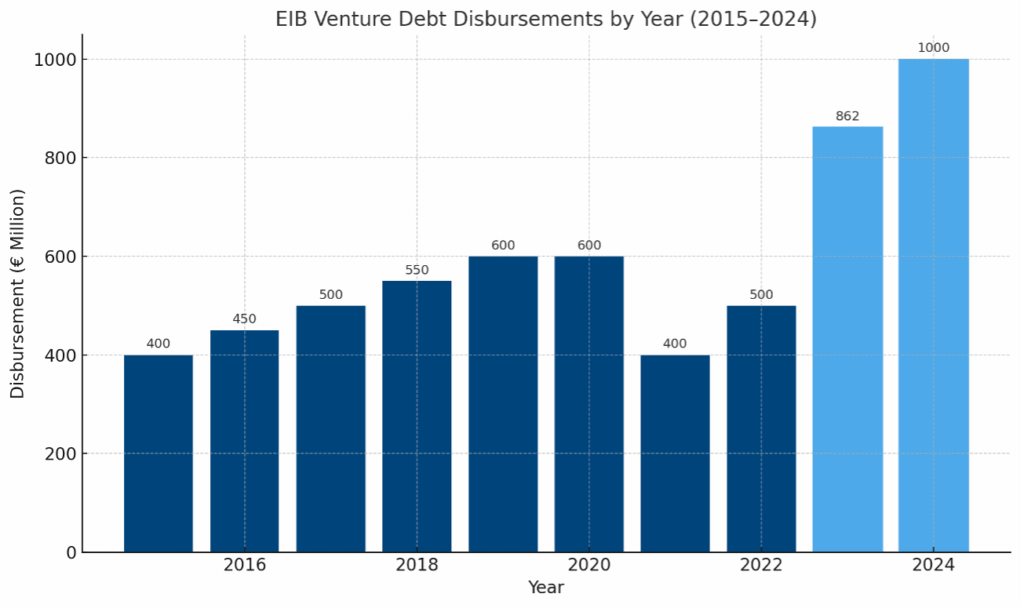
When the European Investment Bank (EIB) began offering venture debt in 2015, it was seen as a bold experiment in startup financing. A decade later, the scale and consistency of its investment tell a different story: venture debt isn’t a fringe product, it’s a foundational part of how European startups grow.
More than 200 companies have received EIB venture debt since the program’s inception, totaling more than €6 billion in deployed capital and contributing to over 50 successful exits. In 2024 alone, the EIB committed a record €1 billion in venture debt.
This isn’t just a European story—it’s a lesson for founders everywhere, especially in the U.S., where venture debt still isn’t as well understood or widely embraced. While American startups often treat debt as a last resort, their European counterparts have taken a more strategic approach to building capital stacks. And in today’s tighter funding environment, that mindset offers a clear advantage.
The EIB’s Venture Debt Model and What It Signals
EIB’s venture debt program was designed to bridge a well-known funding gap: the “valley of death” that often follows early-stage equity rounds but precedes meaningful revenue or late-stage VC interest. Structured as long-term loans with flexible repayment terms, EIB venture debt supports capital-intensive sectors like climate tech, deep tech, and life sciences—sectors where European startups have made significant strides in recent years.
The scale of the program speaks volumes. In 2023, the EIB disbursed €862 million in venture debt; the following year, it crossed the €1 billion mark, further proof that this is no longer a niche instrument. Backed by the EU and guided by a mission to strengthen innovation across the continent, the EIB is betting on debt as a lever for growth.
It’s doubling down on that bet: under its newly announced Tech EU initiative, the EIB plans to allocate €70 billion between 2025 and 2027—including €40 billion in loans, €20 billion in quasi-equity, and €10 billion in guarantees.
The European Perspective: Strategic, Not Defensive
European founders, often operating with more constrained funding options and fewer mega-rounds, have adapted by being more strategic. They understand that equity is expensive—and not always the right tool for every job. Venture debt is used proactively: to extend runway, bridge to milestones, or fund large capital expenditures (like equipment or infrastructure) that equity investors may hesitate to back.
As a result, venture debt has become normalized across European startups. There’s less stigma around debt, and more alignment between capital type and business need.
The U.S. Hesitation
In contrast, many U.S. startups still regard venture debt as a signal of weakness—a stopgap measure when equity financing falls through. That perception, while slowly evolving, continues to limit how founders think about capital strategy. Even as equity rounds take longer to close and valuations compress, some U.S. founders avoid debt entirely, leaving valuable financing options on the table.
This is especially ironic given how sophisticated the American venture ecosystem is in so many other respects. Non-bank lenders, equipment financiers, and venture debt specialists are widely available. But unless founders approach them early and with clear intent, they may miss the opportunity to use debt as a strategic advantage.
What U.S. Startups Can Learn
The lesson from Europe isn’t to replace equity with debt—it’s to think holistically about capital. Not every dollar needs to come from dilution. Used wisely, venture debt helps:
Extend runway without giving up ownership
Finance assets that generate revenue or operational efficiency
De-risk the timing between funding milestones
Preserve founder and early investor equity ahead of major valuation inflection points
The European Investment Bank has helped prove this out at scale. More than 200 companies have leveraged its venture debt program, many achieving successful exits as a result. The takeaway is clear: venture debt, when structured thoughtfully and aligned with company goals, creates flexibility and resilience.
Final Thought
If European startups have learned to treat debt as a tool—not a red flag—then perhaps it’s time more U.S. founders did the same. The funding climate in 2025 demands creativity, efficiency, and strategic capital planning. That doesn’t mean raising less money; it means raising smarter money.
Venture debt is not a last resort. It’s a sign of a founder who understands the full range of financial instruments available—and knows how to use them to build a stronger company.
After the exuberance of 2021 and the correction that followed, the VC landscape in 2025 is marked by discipline, selectivity, and a renewed focus on fundamentals. That doesn’t mean venture capital is dead; it means it’s evolving.
Founders looking to raise in this market need to understand what investors are prioritizing—and how they can build financing strategies that reflect this new reality. One of the most overlooked tools in that toolkit? Venture debt.
A Shift in Mindset
We’re seeing VCs scrutinize new deals with fresh eyes. Some of the patterns:
Capital efficiency is top of mind: Investors are more cautious about burn rates, preferring companies that show strong operational discipline.
Milestone-based funding is the norm: Firms want to see clear use of proceeds and validated traction before deploying more capital.
Valuation sensitivity has returned: Founders are less likely to name their price; VCs are looking for realistic cap tables and sober assessments.
It’s no surprise that deals are taking longer, rounds are smaller, and more equity funding is going toward follow-on rather than net new bets.
Where Venture Debt Fits
In this environment, founders who rely exclusively on equity may find themselves compromising, whether that means giving up too much control, pausing growth plans, or struggling to close the round at all, none of which is desirable.
Venture debt offers a middle path, through non-dilutive loans that let founders:
Extend their runway to hit the next milestone
Fund capex and long-lead-time assets
Close the gap between equity rounds on favorable terms
Importantly, we work alongside equity investors, not in competition with them. For VCs, our capital reduces the need for oversized rounds. For founders, it creates breathing room to raise on better terms.
A Stronger Stack
The most successful startups in 2025 aren’t the ones with the flashiest pitch decks. They’re the ones that build a smart, durable capital stack, one that aligns with investor expectations and company goals alike.
Venture debt is a strategic complement to equity in this new era of capital discipline. Founders who understand what VCs want—and show they’re thinking two steps ahead—will stand out.
According to the recent PitchBook-NVCA Venture Monitor, the median time between venture rounds is increasing, meaning startups need to be more strategic about how they manage capital. For many founders, timing has never been more critical.
With IPO markets still recovering and late-stage valuations stabilizing, companies that optimize their financial runway will be best positioned to scale efficiently and secure future funding on favorable terms. This is where we are seeing venture debt playing a crucial role—not as a last resort, but as a smart financing tool that gives founders more control over their trajectory.
Why Timing Matters More Than Ever
For many startups, the gap between fundraising rounds is widening, according to the PitchBook data. In the years following the peak of the venture boom, investors have become more selective, and deals are taking longer to close. Raising funds in a down market is something founders would rather avoid, so startups need to find ways to maintain momentum while waiting for the right market conditions to raise their next round.
Raising too soon—especially in a period of compressed valuations—can lead to excessive dilution and limit a founder’s ability to maximize long-term value. But waiting too long without sufficient capital can mean missing key milestones, slowing growth, or losing competitive advantage.
This is where venture debt can serve as a strategic bridge, giving startups the financial flexibility to hit key targets, strengthen their valuation, and approach equity markets from a position of strength.
How Venture Debt Helps Founders Stay in Control
Here’s how startups are leveraging venture debt to stay ahead in today’s market:
1. Extending Runway Without Dilution: For startups that are approaching key milestones—whether it’s product development, customer acquisition, or revenue benchmarks—venture debt offers a way to keep operations moving without the immediate need for a dilutive equity raise.
Many founders use venture debt to buy time, ensuring they can reach a higher valuation before their next funding round. This means negotiating from a position of strength, rather than being forced to accept lower terms due to cash constraints.
2. Investing in Growth at the Right Moment: Over the past 25 years we’ve been in venture debt, we’ve seen time and again that startups don’t grow in a straight line. Some opportunities require immediate investment, whether it’s scaling a sales team, launching in a new market, making a critical hire or investing in specialist equipment or technology.
Venture debt allows companies to act on these opportunities without waiting for the next equity round. This agility is especially important in competitive markets, where timing can determine whether a company gains or loses market share.
3. Strengthening Financial Positioning for Future Raises: For startups planning a Series B or C, venture debt can be used to optimize financial health ahead of a funding round. By using debt capital to support operations, companies can demonstrate stronger revenue growth, improved margins, and greater capital efficiency—all factors that increase investor confidence and lead to better fundraising outcomes.
Instead of relying purely on equity to finance expansion, we are seeing many venture-backed startups balancing their capital stack with debt to create a more sustainable financial model.
Where Venture Debt is Making the Biggest Impact
Venture debt is playing a key role in helping companies across high-growth, capital-intensive industries scale efficiently. Some of the most impactful applications include:
Space Technology – Companies like Stoke Space and Astranis are leveraging venture debt to fund critical R&D, infrastructure, and expansion. Stoke Space is advancing fully reusable rocket systems, while Astranis is deploying next-generation broadband satellites to improve global connectivity.
Clean Energy and Sustainability – Startups such as SolarCycle and Terabase Energy are using venture debt to accelerate solar infrastructure and recycling solutions, ensuring sustainable energy remains at the forefront of innovation.
Advanced Materials and Manufacturing – Companies like MycoWorks, which develops sustainable biomaterials, and LuxWall, which specializes in energy-efficient glass, are securing funding to scale production and meet increasing demand.
Biotech and Life Sciences – Nobell Foods and Outpace Bio are applying venture debt to fund scientific development, commercialization, and market expansion in food technology and biotech.
Transportation and Mobility – Companies like Harbinger Motors, a leader in electric commercial vehicle technology, are using venture debt to expand manufacturing capacity and accelerate deployment.
Across these industries, venture debt isn’t just providing capital, it’s enabling companies to move faster, strengthen their financial position, and scale with confidence.
A Smarter Approach to Startup Financing
At ATEL Ventures, we work with founders to design flexible, customized venture debt solutions that align with their business goals. We believe venture debt should empower startups, providing financial runway without unnecessary restrictions or dilution.
For startups navigating today’s venture landscape, the right financing strategy is about more than just raising money—it’s about timing, control, and long-term value creation. Venture debt offers a way to achieve all three.
In the startup world, “debt” can sound like a four-letter word. Founders are often encouraged to chase equity rounds and avoid debt at all costs. But that thinking overlooks one of the most strategic, founder-friendly tools available: non-dilutive capital in the form of both venture debt and equipment financing.
At ATEL Ventures, we’ve seen firsthand how flexible capital structures can help startups reach key milestones, extend runway, and scale with confidence — often paving the way to an IPO or acquisition. The proof? Our portfolio.
Public Companies That Used Non-Dilutive Capital to Fuel Growth
Initial Public Offerings (IPOs) may be a rarity these days, but several companies that took advantage of venture debt or equipment financing from ATEL Ventures have gone on to become publicly traded, building long-term value in capital-intensive industries like energy, life sciences, and cloud infrastructure. Their stories highlight how the right capital, at the right time, can make a defining difference:
DigitalOcean: DigitalOcean offers cloud computing services tailored for developers, startups, and small to medium-sized businesses. ATEL Ventures extended equipment financing during the company’s early stages, facilitating the enhancement of its infrastructure and service offerings. DigitalOcean completed its IPO in March 2021 and its market capitalization today stands at around $4.5 billion.
Skillz: Skillz is a mobile gaming platform that enables developers to create and monetize multiplayer competitions, and ATEL Ventures provided non-dilutive capital to support its expansion efforts. The company went public in December 2020 via a merger with a special purpose acquisition company (SPAC) and now has a market capitalization of approximately $1.2 billion.
Other companies that ATEL Ventures has supported over the years that have gone public include: Bloom Energy, which develops solid oxide fuel cell technology for clean, reliable on-site energy generation; Twist Bioscience, which specializes in synthetic DNA production for applications in healthcare, agriculture, and industrial chemicals; Five9, which provides cloud-based contact center solutions; and Boingo Wireless, a provider of global Wi-Fi services across airports, stadiums, and other high-traffic venues.
Acquisitions and Other Successful Exits
Non-dilutive capital from ATEL — whether through venture debt or equipment financing — has also played a role in supporting high-impact startups through acquisitions and other strategic exits. These outcomes validate that flexible capital isn’t a compromise, it’s a catalyst. Success stories within the ATEL Ventures portfolio include:
Omniome: ATEL Ventures provided equipment financing to support Omniome’s development of innovative DNA sequencing technologies for clinical and research applications. In July 2021, Pacific Biosciences (PacBio) acquired Omniome for approximately $800 million.
TriLumina: TriLumina developed compact semiconductor laser arrays for 3D sensing applications, particularly in automotive and consumer electronics. ATEL Ventures provided equipment financing to facilitate the company’s technological advancements. TriLumina was acquired by Lumentum Holdings in 2020.
ViaCyte: ATEL Ventures’ support helped fund ViaCyte’s development of stem cell-derived therapies for diabetes treatment. Vertex Pharmaceuticals acquired the company for $320 million in August 2022.
Other companies in the ATEL Ventures portfolio that have had successful exits via acquisition include: Luxtera, a pioneer of silicon photonics technology for high-speed optical networking (acquired by Cisco Systems); Sensity, which developed smart city solutions using sensor-based lighting and data platforms (acquired by Verizon); SilverPop, a pioneer of marketing automation and behavioral email marketing (acquired by IBM); and Tegile Systems, which offered flash storage arrays for enterprise data centers (acquired by Western Digital).
Non-Dilutive Capital as a Growth Lever
These success stories underscore that venture debt and equipment financing are strategic instruments for growth. By providing non-dilutive capital, ATEL Ventures helps startups scale operations, invest in innovation, and position themselves for successful exits.
The challenges facing space tech startups are as vast as the cosmos they seek to explore. From the significant upfront capital required for R&D, manufacturing, and launch infrastructure to the long timelines before revenue generation, these companies operate in one of the most capital-intensive sectors of the startup ecosystem. For founders in space tech, securing funding is not just about keeping the lights on—it’s about ensuring their vision for the future of space exploration, satellite technology, or launch systems can even get off the ground. This is where venture debt plays a critical role.
The High-Stakes Reality of Space Tech
Space tech exemplifies what many call ‘hard tech’—an industry requiring substantial breakthroughs and significant barriers to entry. Unlike software startups that can iterate quickly, space tech companies must contend with high material costs, specialized labor, long R&D cycles, and complex regulatory hurdles. These factors make traditional venture capital (VC) funding alone an insufficient solution.
Venture debt, however, provides an attractive complement. It allows startups to secure non-dilutive capital to finance equipment, extend their runway, and bridge funding gaps without giving up significant ownership. This financing model has already proven effective for several notable space tech companies, including Astranis, Stoke Space, and Isar Aerospace, all of which have leveraged venture debt to propel their ambitious missions forward.
Case Studies: When Venture Debt Works in Space Tech
Astranis: Connecting the World from Space
Astranis is a prime example of why venture debt is vital in space tech. The company, which designs and builds small geostationary satellites to provide internet access in remote regions, has raised over $500 million through a combination of venture rounds and debt financing. Founded in 2015, Astranis launched its first satellite in 2023—an eight-year journey requiring substantial capital to cover development, manufacturing, and regulatory approvals. Venture debt enabled the company to extend its financial runway without over-relying on equity funding, ensuring it could bring its MicroGEO satellite technology to market.
Stoke Space: Pioneering Reusable Rockets
Stoke Space, focused on developing fully reusable launch vehicles, exemplifies another area where venture debt provides a strategic advantage. The company is tackling one of the most significant challenges in modern aerospace—drastically reducing the cost of space access through reusability. Given the capital-intensive nature of rocket development, Stoke Space has combined venture funding with debt financing to cover essential infrastructure, testing, and manufacturing costs. This approach allows the company to invest in long-term R&D while maintaining flexibility in its fundraising strategy.
Isar Aerospace: Democratizing Access to Space
Germany’s Isar Aerospace is another space tech startup leveraging venture debt to achieve its vision. The company is developing Spectrum, a cost-effective, small- and medium-satellite launch vehicle designed to improve access to orbit for commercial and institutional customers. Like its U.S. counterparts, Isar Aerospace faces long development timelines and high upfront costs. Venture debt provides a capital-efficient way to fund the company’s operational expansion, enabling it to scale without excessive dilution of founder equity.
Why Venture Debt Makes Sense for Space Tech
The unique challenges of space tech make venture debt particularly appealing for startups in this sector:
Extending runway without dilution: Unlike equity funding, venture debt allows founders to maintain greater ownership, which is crucial given the long time horizons before profitability.
Funding capital-intensive equipment needs: From launch facilities to satellite manufacturing, space tech requires substantial physical assets. Debt financing helps fund these without diverting equity capital.
Bridging financing gaps: Many space startups experience delays in development or launch schedules. Venture debt provides a financial buffer to navigate these challenges without disrupting operations.
Supporting growth between rounds: Companies like Astranis and Stoke Space have successfully used venture debt to supplement VC rounds, ensuring consistent progress even when markets are volatile.
The Future of Space Tech Funding
As space tech continues to evolve, the role of venture debt will only grow in importance. Investors and founders alike are recognizing that non-dilutive financing is not just a bridge between venture rounds—it’s a strategic tool that allows companies to scale efficiently, maintain financial flexibility, and bring game-changing innovations to market.
U.S. venture capital firms invested over $180 billion into high-potential startups in 2024, marking a 27% increase from the previous year. A significant portion of this investment was directed toward sectors such as artificial intelligence (AI), clean energy, and life sciences.
Venture capital remains a powerful force in startup financing—and companies that take a strategic approach to financing are in a strong position to thrive.
At ATEL Ventures, we’ve seen firsthand how savvy founders are using a mix of capital sources—venture equity, non-dilutive funding, and venture debt—to build and scale their businesses efficiently. Venture debt, in particular, is playing an increasingly valuable role in helping startups extend runway, accelerate growth, and maintain control over their future.
A Smarter Approach to Startup Financing
Venture debt is never a substitute for equity financing, but it does serve as a complement, offering companies an additional layer of flexibility and allowing them to fund growth initiatives, strengthen their financial position, and delay or optimize the timing of their next equity round.
By leveraging venture debt, startups can:
Extend their runway between equity rounds while maintaining more ownership
Invest in growth initiatives such as customer acquisition, hiring, and product expansion
Reduce dilution in an environment where valuation fluctuations may make equity funding more costly—long term, taking on venture debt is less expensive than surrendering equity, even more so when valuations are low
Build financial resilience, ensuring they have the flexibility to respond to opportunities and challenges
Maximizing Control and Optionality
In 2025 we see startups taking a much more deliberate approach to when and how they raise equity capital. Rather than raising funds at a suboptimal valuation, many are using venture debt to bridge funding gaps and reach milestones that increase their attractiveness to investors.
This approach allows founders to retain more ownership and maintain stronger negotiating power when the time comes to raise their next round.
Supporting Growth Across Key Sectors
We see companies across space technology, life sciences, AI, renewable energy, and advanced manufacturing successfully integrating venture debt into their financing strategies:
High-growth hardware companies are using venture debt to fund capital-intensive infrastructure
SaaS and AI startups are leveraging it for customer acquisition without excessive dilution
Climate tech and deep tech companies are using it to fund commercialization and scale production
A Positive Outlook for Venture Debt
Venture debt has long been a go-to strategy for well-funded startups looking to optimize their capital structure, and that remains true today. With non-bank lenders offering increasingly tailored solutions, the flexibility available to startups has never been greater.
At ATEL Ventures, we don’t see venture debt as a last resort—we see it as a sign of smart financial leadership. The startups that strategically combine equity and debt financing will be best positioned to scale efficiently, preserve ownership, and maximize long-term value.