ATEL Ventures Inc., a leading provider of secured financing to emerging growth and start-up companies, is seeking a highly motivated and dynamic Vice President, Venture Debt Originator to join our expanding team. This is a unique opportunity for an ambitious professional with a passion for helping innovative companies access capital to grow and succeed.
Qualifications
What We’re Looking For
Experience: Minimum of 3 years of venture debt lending experience with a proven track record of sourcing and closing deals with emerging companies.
Financial and Market Insight: Solid understanding of venture debt structures, start-up financials, and risk analysis. Able to quickly evaluate the financial health and growth potential of start-up companies.
Relationship Builder: Exceptional networking, communication, and negotiation skills, with the ability to build rapport with founders, executives, and venture capital partners.
Self-Starter with a Growth Mindset: Proactive and driven, with an entrepreneurial spirit. Thrives in a fast-paced environment and seeks opportunities for professional growth.
Education: Bachelor’s Degree in Finance, Business Administration or Management, Economics, Entrepreneurship or related field. Master’s degree preferred.
Duties and Responsibilities
Drive Business Development: Source and originate venture debt deals by building relationships with high-growth start ups and their investors. Leverage your network in the venture capital and start-up ecosystem to identify and engage potential clients.
Lead Deal Structuring and Execution: Partner with cross-functional teams to structure and negotiate venture debt solutions tailored to clients’ growth trajectories, focusing on non-dilutive financing strategies.
Cultivate Strong Partnerships: Act as a trusted advisor to founders and executive teams, helping them understand the strategic value of venture debt. Forge long-term relationships with clients, venture capital firms, and other industry influencers.
Contribute to Team Growth and Strategy: Play a critical role in expanding our team of originators, bringing in fresh perspectives and sharing insights to enhance our sourcing strategies. Your role will have a direct impact on the growth of ATEL’s venture debt portfolio.
Benefits
We offer a competitive compensation package, including base salary plus commission, comprehensive benefits, and the opportunity to thrive in a supportive work environment. Our culture values growth, collaboration, and innovation, and you’ll be surrounded by a team of passionate, driven professionals dedicated to making a meaningful impact.
Medical, dental, vision, and life insurance
Vacation, sick leave and 10 paid holidays
Flexible Spending Account and Dependent Care pretax benefits
Pretax benefits for transit and parking
401(k) with generous employer match
Why ATEL Ventures?
Impactful Work: Join a team that is fueling innovation by helping visionary entrepreneurs access the capital they need.
Collaborative Culture: Be part of a close-knit team that values collaboration, and shared success.
Professional Growth: ATEL Ventures is committed to your development and offers pathways to expand your skills and responsibilities as we grow.
If you’re ready to make a meaningful impact in venture debt financing, we’d love to hear from you!
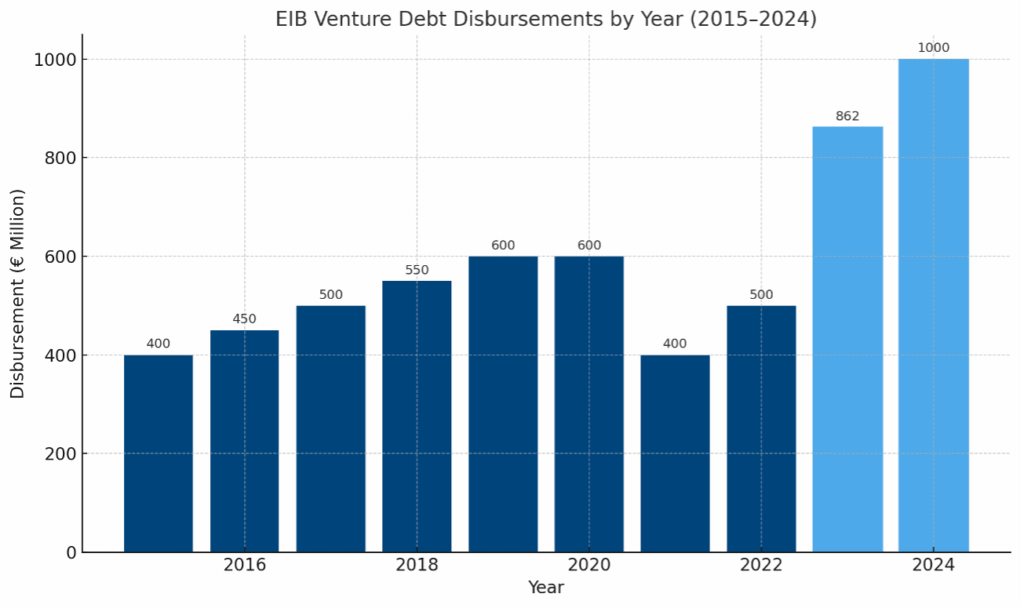
When the European Investment Bank (EIB) began offering venture debt in 2015, it was seen as a bold experiment in startup financing. A decade later, the scale and consistency of its investment tell a different story: venture debt isn’t a fringe product, it’s a foundational part of how European startups grow.
More than 200 companies have received EIB venture debt since the program’s inception, totaling more than €6 billion in deployed capital and contributing to over 50 successful exits. In 2024 alone, the EIB committed a record €1 billion in venture debt.
This isn’t just a European story—it’s a lesson for founders everywhere, especially in the U.S., where venture debt still isn’t as well understood or widely embraced. While American startups often treat debt as a last resort, their European counterparts have taken a more strategic approach to building capital stacks. And in today’s tighter funding environment, that mindset offers a clear advantage.
The EIB’s Venture Debt Model and What It Signals
EIB’s venture debt program was designed to bridge a well-known funding gap: the “valley of death” that often follows early-stage equity rounds but precedes meaningful revenue or late-stage VC interest. Structured as long-term loans with flexible repayment terms, EIB venture debt supports capital-intensive sectors like climate tech, deep tech, and life sciences—sectors where European startups have made significant strides in recent years.
The scale of the program speaks volumes. In 2023, the EIB disbursed €862 million in venture debt; the following year, it crossed the €1 billion mark, further proof that this is no longer a niche instrument. Backed by the EU and guided by a mission to strengthen innovation across the continent, the EIB is betting on debt as a lever for growth.
It’s doubling down on that bet: under its newly announced Tech EU initiative, the EIB plans to allocate €70 billion between 2025 and 2027—including €40 billion in loans, €20 billion in quasi-equity, and €10 billion in guarantees.
The European Perspective: Strategic, Not Defensive
European founders, often operating with more constrained funding options and fewer mega-rounds, have adapted by being more strategic. They understand that equity is expensive—and not always the right tool for every job. Venture debt is used proactively: to extend runway, bridge to milestones, or fund large capital expenditures (like equipment or infrastructure) that equity investors may hesitate to back.
As a result, venture debt has become normalized across European startups. There’s less stigma around debt, and more alignment between capital type and business need.
The U.S. Hesitation
In contrast, many U.S. startups still regard venture debt as a signal of weakness—a stopgap measure when equity financing falls through. That perception, while slowly evolving, continues to limit how founders think about capital strategy. Even as equity rounds take longer to close and valuations compress, some U.S. founders avoid debt entirely, leaving valuable financing options on the table.
This is especially ironic given how sophisticated the American venture ecosystem is in so many other respects. Non-bank lenders, equipment financiers, and venture debt specialists are widely available. But unless founders approach them early and with clear intent, they may miss the opportunity to use debt as a strategic advantage.
What U.S. Startups Can Learn
The lesson from Europe isn’t to replace equity with debt—it’s to think holistically about capital. Not every dollar needs to come from dilution. Used wisely, venture debt helps:
Extend runway without giving up ownership
Finance assets that generate revenue or operational efficiency
De-risk the timing between funding milestones
Preserve founder and early investor equity ahead of major valuation inflection points
The European Investment Bank has helped prove this out at scale. More than 200 companies have leveraged its venture debt program, many achieving successful exits as a result. The takeaway is clear: venture debt, when structured thoughtfully and aligned with company goals, creates flexibility and resilience.
Final Thought
If European startups have learned to treat debt as a tool—not a red flag—then perhaps it’s time more U.S. founders did the same. The funding climate in 2025 demands creativity, efficiency, and strategic capital planning. That doesn’t mean raising less money; it means raising smarter money.
Venture debt is not a last resort. It’s a sign of a founder who understands the full range of financial instruments available—and knows how to use them to build a stronger company.
ATEL Ventures has completed an agreement to provide $10M of growth capital to Vial, a next-generation pharma company.
Founded in 2020 and headquartered in San Francisco, California, Vial is a clinical-stage biotech company based in San Francisco that has raised $100M+ to date from leading life sciences investors including General Catalyst, Buckley Ventures, and Byers Capital. Vial is focused on advancing a pipeline of potentially best-in-class biologics and RNA therapeutics across areas of unmet medical need.
Vial recently initiated dosing of healthy volunteers in its first clinical trial for a novel subcutaneous, extended half-life monoclonal antibody targeting TL1A, which is being developed as a potentially best-in-class treatment for people living with moderate-to-severe IBD, as well as other I&I and fibrotic diseases. The $10M from ATEL Ventures will complement Vial’s historical equity financings and enable the Vial team to advance additional assets into the clinic in 2025, leveraging its vertically integrated drug development, clinical trial technology, and clinical operations platform.
“Drug development and clinical trials have always been slow-moving and capital-intensive,” said Steven Rea, President, ATEL Ventures. “Vial’s platform turns all of that on its head, streamlining the process and enabling new drugs to get to market that much faster.”
“We are reimagining drug development, using technology to build for scale,” said Simon Burns, CEO of Vial. The financing from ATEL complements our historical equity funding and supports our ability to accelerate the number of clinical stage assets in our pipeline.
After the exuberance of 2021 and the correction that followed, the VC landscape in 2025 is marked by discipline, selectivity, and a renewed focus on fundamentals. That doesn’t mean venture capital is dead; it means it’s evolving.
Founders looking to raise in this market need to understand what investors are prioritizing—and how they can build financing strategies that reflect this new reality. One of the most overlooked tools in that toolkit? Venture debt.
A Shift in Mindset
We’re seeing VCs scrutinize new deals with fresh eyes. Some of the patterns:
Capital efficiency is top of mind: Investors are more cautious about burn rates, preferring companies that show strong operational discipline.
Milestone-based funding is the norm: Firms want to see clear use of proceeds and validated traction before deploying more capital.
Valuation sensitivity has returned: Founders are less likely to name their price; VCs are looking for realistic cap tables and sober assessments.
It’s no surprise that deals are taking longer, rounds are smaller, and more equity funding is going toward follow-on rather than net new bets.
Where Venture Debt Fits
In this environment, founders who rely exclusively on equity may find themselves compromising, whether that means giving up too much control, pausing growth plans, or struggling to close the round at all, none of which is desirable.
Venture debt offers a middle path, through non-dilutive loans that let founders:
Extend their runway to hit the next milestone
Fund capex and long-lead-time assets
Close the gap between equity rounds on favorable terms
Importantly, we work alongside equity investors, not in competition with them. For VCs, our capital reduces the need for oversized rounds. For founders, it creates breathing room to raise on better terms.
A Stronger Stack
The most successful startups in 2025 aren’t the ones with the flashiest pitch decks. They’re the ones that build a smart, durable capital stack, one that aligns with investor expectations and company goals alike.
Venture debt is a strategic complement to equity in this new era of capital discipline. Founders who understand what VCs want—and show they’re thinking two steps ahead—will stand out.
According to the recent PitchBook-NVCA Venture Monitor, the median time between venture rounds is increasing, meaning startups need to be more strategic about how they manage capital. For many founders, timing has never been more critical.
With IPO markets still recovering and late-stage valuations stabilizing, companies that optimize their financial runway will be best positioned to scale efficiently and secure future funding on favorable terms. This is where we are seeing venture debt playing a crucial role—not as a last resort, but as a smart financing tool that gives founders more control over their trajectory.
Why Timing Matters More Than Ever
For many startups, the gap between fundraising rounds is widening, according to the PitchBook data. In the years following the peak of the venture boom, investors have become more selective, and deals are taking longer to close. Raising funds in a down market is something founders would rather avoid, so startups need to find ways to maintain momentum while waiting for the right market conditions to raise their next round.
Raising too soon—especially in a period of compressed valuations—can lead to excessive dilution and limit a founder’s ability to maximize long-term value. But waiting too long without sufficient capital can mean missing key milestones, slowing growth, or losing competitive advantage.
This is where venture debt can serve as a strategic bridge, giving startups the financial flexibility to hit key targets, strengthen their valuation, and approach equity markets from a position of strength.
How Venture Debt Helps Founders Stay in Control
Here’s how startups are leveraging venture debt to stay ahead in today’s market:
1. Extending Runway Without Dilution: For startups that are approaching key milestones—whether it’s product development, customer acquisition, or revenue benchmarks—venture debt offers a way to keep operations moving without the immediate need for a dilutive equity raise.
Many founders use venture debt to buy time, ensuring they can reach a higher valuation before their next funding round. This means negotiating from a position of strength, rather than being forced to accept lower terms due to cash constraints.
2. Investing in Growth at the Right Moment: Over the past 25 years we’ve been in venture debt, we’ve seen time and again that startups don’t grow in a straight line. Some opportunities require immediate investment, whether it’s scaling a sales team, launching in a new market, making a critical hire or investing in specialist equipment or technology.
Venture debt allows companies to act on these opportunities without waiting for the next equity round. This agility is especially important in competitive markets, where timing can determine whether a company gains or loses market share.
3. Strengthening Financial Positioning for Future Raises: For startups planning a Series B or C, venture debt can be used to optimize financial health ahead of a funding round. By using debt capital to support operations, companies can demonstrate stronger revenue growth, improved margins, and greater capital efficiency—all factors that increase investor confidence and lead to better fundraising outcomes.
Instead of relying purely on equity to finance expansion, we are seeing many venture-backed startups balancing their capital stack with debt to create a more sustainable financial model.
Where Venture Debt is Making the Biggest Impact
Venture debt is playing a key role in helping companies across high-growth, capital-intensive industries scale efficiently. Some of the most impactful applications include:
Space Technology – Companies like Stoke Space and Astranis are leveraging venture debt to fund critical R&D, infrastructure, and expansion. Stoke Space is advancing fully reusable rocket systems, while Astranis is deploying next-generation broadband satellites to improve global connectivity.
Clean Energy and Sustainability – Startups such as SolarCycle and Terabase Energy are using venture debt to accelerate solar infrastructure and recycling solutions, ensuring sustainable energy remains at the forefront of innovation.
Advanced Materials and Manufacturing – Companies like MycoWorks, which develops sustainable biomaterials, and LuxWall, which specializes in energy-efficient glass, are securing funding to scale production and meet increasing demand.
Biotech and Life Sciences – Nobell Foods and Outpace Bio are applying venture debt to fund scientific development, commercialization, and market expansion in food technology and biotech.
Transportation and Mobility – Companies like Harbinger Motors, a leader in electric commercial vehicle technology, are using venture debt to expand manufacturing capacity and accelerate deployment.
Across these industries, venture debt isn’t just providing capital, it’s enabling companies to move faster, strengthen their financial position, and scale with confidence.
A Smarter Approach to Startup Financing
At ATEL Ventures, we work with founders to design flexible, customized venture debt solutions that align with their business goals. We believe venture debt should empower startups, providing financial runway without unnecessary restrictions or dilution.
For startups navigating today’s venture landscape, the right financing strategy is about more than just raising money—it’s about timing, control, and long-term value creation. Venture debt offers a way to achieve all three.